The standard half rack is a compact, durable, and multi-functional core strength training apparatus widely adopted in commercial gyms and home fitness spaces. Featuring a streamlined structural design and professional safety configurations, it balances training practicality and space efficiency perfectly. Different from the bulky full power rack, the standard half rack retains all essential functions for mainstream barbell training while occupying minimal floor area. It suits fitness enthusiasts of all levels, from beginners to professional lifters, and serves as an all-in-one solution for systematic strength training. This article elaborates on its core structural strengths, diverse training functions, and targeted muscle groups to clarify its value in modern strength fitness.
Compact Structural Design and Superior Safety Performance
Diversified Core Training Functions
Targeted Muscle Groups for Systematic Training
Compact Structural Design and Superior Safety Performance
The standard half rack adopts a simplified and optimized frame structure, mainly consisting of two high-strength steel uprights, adjustable J-hooks, safety spotter arms, and an optional top pull-up crossbar. Without the enclosed four-sided frame of a full power cage, it features an open design that greatly improves access flexibility for trainers during movements. Made of thickened industrial steel, the rack boasts strong load-bearing capacity, with mainstream models supporting a weight range from 200kg to over 500kg, fully meeting the demands of daily amateur training and high-intensity professional weightlifting.
Safety is the core advantage of the standard half rack. The height of J-hooks and safety arms can be adjusted freely according to different exercise types, trainer heights, and movement ranges. The safety arms act as a reliable protective barrier, effectively catching the barbell in case of fatigue or failed movements, preventing equipment damage and physical injury. Meanwhile, the stable base structure avoids shaking or tipping during heavy-load training, ensuring overall training stability. Its compact size saves nearly half the floor space compared with full power racks, making it the preferred equipment for small home gyms and boutique fitness studios.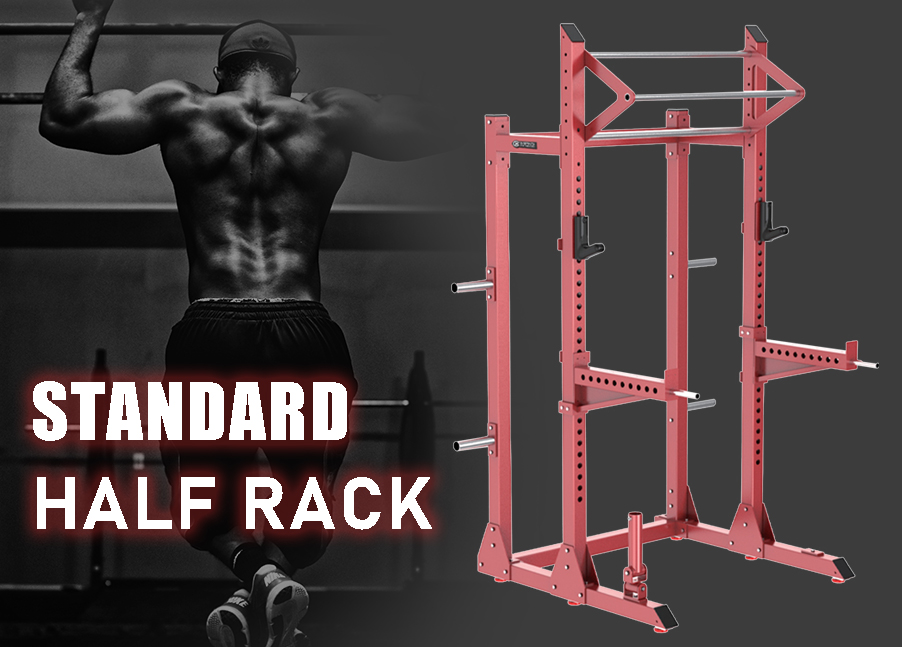
Diversified Core Training Functions
Despite its simplified structure, the standard half rack integrates comprehensive strength training functions, covering almost all mainstream compound and partial weightlifting movements, realizing multi-purpose training with one device. Its most classic core function is supporting barbell squat training, including back squats and front squats, the foundational movements for lower body strength improvement. Equipped with a matched fitness bench, it can efficiently complete bench presses and incline presses, covering chest and upper limb pushing training.
In addition, the standard half rack supports overhead barbell presses, rack pulls, deadlifts, and barbell rows, covering vertical pressing, horizontal pulling, and hip hinge training modes. Most standard half racks are equipped with a top pull-up bar, enabling bodyweight pull-ups and chin-ups for back and arm training. With additional auxiliary accessories such as pulley systems and dip bars, it can also expand diversified training items including lat pulldowns, tricep dips, and core stabilization training. This highly expandable functionality breaks the limitation of single-function fitness equipment, greatly enriching training combinations and improving the efficiency of full-body strength workouts.
Targeted Muscle Groups for Systematic Training
The standard half rack focuses on compound strength training, which can activate and exercise major muscle groups of the whole body in a targeted manner, realizing systematic and balanced muscle development. For the lower body, squat and rack pull movements mainly target the quadriceps femoris, gluteus maximus, and hamstrings, while also stimulating calf muscles and hip flexors, effectively improving lower body explosive power and muscle endurance. Deadlift movements further strengthen the posterior chain muscles, including the erector spinae of the lower back, helping improve core stability and body posture.
For the upper body, bench presses and overhead presses primarily exercise the pectoralis major, anterior deltoids, and triceps, shaping full chest and shoulder muscle lines and enhancing upper body pushing strength. Pull-ups and barbell row movements focus on training the latissimus dorsi, trapezius, biceps, and rear deltoids, which are crucial for improving back thickness and upper body pulling ability. Moreover, all heavy-load compound movements assisted by the half rack require the deep engagement of the abdominal muscles, obliques, and transverse abdominis to maintain body balance, enabling simultaneous core muscle training. Through targeted training of upper body, lower body, and core muscle groups, the standard half rack helps users build a balanced, strong, and well-proportioned muscle system.
In conclusion, the standard half rack stands out among strength training equipment by virtue of its safe structure, space-saving design, and ultra-high training versatility. It not only meets the basic strength training needs of fitness beginners but also supports progressive heavy-load training for advanced lifters, making it a cost-effective and practical core equipment for long-term fitness improvement.


